
If you’ve ever spent a sunny afternoon on the King’s Road, you know the vibe. It’s iconic, it’s vibrant, and: if you happen to live there: it is incredibly loud.
For many residents in the Royal Borough of Kensington and Chelsea, the dream of a peaceful garden flat often comes with a caveat: the constant hum of traffic, the occasional siren, and the low-frequency rumble of the Number 22 bus.
We recently worked with Sarah, a homeowner whose Victorian garden flat sat just a few meters back from the main thoroughfare. Her problem wasn’t just the noise; it was the feeling that her home wasn’t truly hers. She found herself subconsciously waiting for the next loud acceleration or the rattle of her original sash windows every time a heavy lorry passed.
The result of our intervention? A staggering reduction in ambient noise that brought her interior levels from a stressful 75 decibels (dB) down to a serene 25-30 dB. That is effectively cutting the noise level by 50dB compared to the street outside: a transformation that changed how she used her home every single day.
The Chelsea Dilemma: Conservation vs. Comfort
Living in a conservation area like Chelsea means you are the guardian of a piece of London’s history. Sarah’s flat featured beautiful, original timber sash windows that were over a century old. They were draughty, thin, and offered almost zero protection against the modern soundscape of West London.
Replacing them wasn't an option Sarah wanted to explore. Not only is it notoriously difficult to get planning permission for full window replacement in Chelsea’s conservation areas, but it’s also expensive and disruptive.
She needed a solution that would:
- Silence the King’s Road: Not just muffle it, but effectively remove it from her living room.
- Stop the Drafts: Her heating bills were high, and her living room felt "leaky."
- Respect the Architecture: The solution had to be invisible from the outside and discreet from the inside.
This is where secondary glazing for period homes in London truly shines. It isn't a compromise; it’s a performance upgrade that outperforms standard double glazing while keeping the original character intact.

The Physics of Silence: How We Hit the 50dB Mark
To achieve a reduction this significant, we can’t just use "thick glass." Sound is a vibration, and different frequencies require different strategies to stop them.
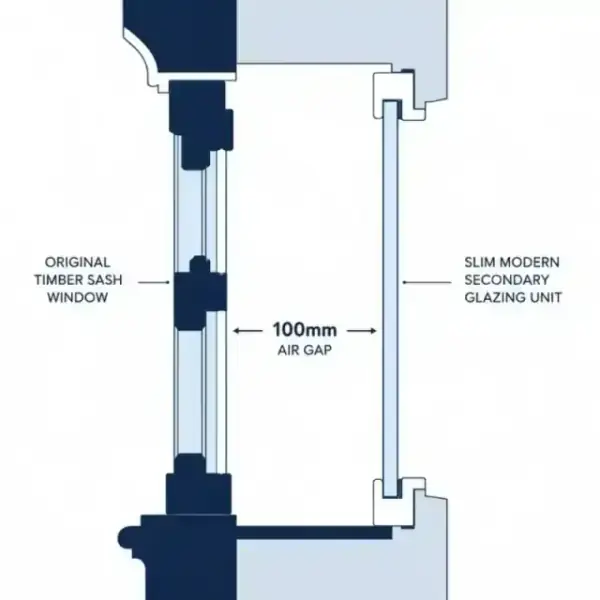
For Sarah’s flat, we designed a bespoke system that utilized 6.4mm Acoustic Laminate glass. Unlike standard glass, acoustic laminate is two sheets of glass bonded together with a special PVB (Polyvinyl Butyral) interlayer. This interlayer acts like a dampener, literally absorbing the energy of the sound waves as they hit the pane.
But the real "secret sauce" in soundproofing flats in Kensington is the air gap.
Standard double-glazing units have a small gap of about 16mm to 20mm. This is great for heat, but for noise: especially low-frequency traffic rumble: it’s too narrow. The sound waves can actually "jump" across that gap.
In Sarah’s flat, we created a 100mm air gap between her original sash and our new secondary unit. This deep cavity creates a massive obstacle for sound. By the time the noise from a passing truck travels through the original glass, across 100mm of air, and hits the acoustic laminate, it has lost almost all its energy.
Design Without Disruption
One of Sarah's biggest concerns was how the new windows would look and function. She loved her garden view and needed to be able to open her original windows for ventilation and cleaning.
We specified Hinged Secondary Glazing units. These are slimline frames that open just like a standard casement window. Because they were custom-made for her reveals, the frames lined up perfectly with her original timber sashes. From the street, you couldn't see them at all. Inside, the slim white frames blended seamlessly with her existing décor.
The installation was surprisingly quick. For her entire garden flat, our team was in and out in less than two days. There was no scaffolding, no messy "hacking out" of old frames, and no need to redecorate. We simply fitted the new units into the existing window reveals.
Measuring the Result: From 75dB to "Whisper Quiet"
To give you an idea of what those numbers mean in the real world:
- 75dB (Outside): The level of a loud vacuum cleaner or constant heavy traffic. It’s the level where you have to raise your voice to be heard.
- 25-30dB (Inside after installation): The level of a library or a quiet bedroom at night.
When we finished the installation, we stood in Sarah’s living room as a bus pulled away from the stop outside. Usually, that would have been the cue for a conversation to pause. Instead, Sarah didn't even notice. The rumble was gone, replaced by a soft, distant hum that was barely audible above the ticking of her wall clock.
Beyond the noise, the thermal benefits were immediate. By adding that extra layer and sealing the gaps, we effectively eliminated the drafts that had plagued the flat for years. Her living room didn't just sound quieter; it felt solid and warm.

Is Secondary Glazing Right for Your London Flat?
If you’re living in a high-noise area like Chelsea, Kensington, or Westminster, you don't have to accept the noise as part of the "city tax."
Secondary glazing London specialists like us focus on these high-performance installations because we know how much they improve quality of life. For Sarah, it meant she could finally enjoy a book in her garden flat without the King’s Road joining in on every page.
If you’re struggling with:
- Street noise that prevents sleep or concentration.
- Drafts and high energy bills from original single-glazed windows.
- Restrictions on changing your windows due to Grade II listing or conservation status.
Then a bespoke acoustic solution might be the answer. You can achieve a level of silence that even modern double glazing often fails to reach, all while keeping the historic charm of your property exactly as it should be.
Want to see what a 50dB drop feels like in your own home? The best way to start is with a professional survey. We can measure your current noise levels and show you exactly how a deep-cavity acoustic system will transform your space.
WhatsApp us