
If you live within earshot of a London "Red Route" or a bustling high street, you know that the city never truly sleeps, it rumbles, honks, and hisses. When homeowners ask us if acoustic glass actually makes a difference compared to standard glass, they aren't looking for a physics lecture; they want to know if they’ll finally be able to hear their own thoughts on a Tuesday morning.
The short answer is yes: but the "how" is where the magic happens. While standard glass relies on brute force (thickness), acoustic glass uses a specialized "sandwich" technology to dampen the specific frequencies that make London traffic so intrusive.
In this guide, we’ll break down why standard glass often fails to silence the city and why a few millimetres of acoustic laminate can feel like moving your house two miles away from the road.
The London Red Route Problem
Living near an arterial road like the A1, A40, or the South Circular presents a unique acoustic challenge. These roads produce a constant "noise floor" of roughly 70–75 decibels (dB). For context, a normal conversation is about 60 dB. Trying to relax in a room where the background noise is louder than a conversation is exhausting.
Most period homes in London still have their original single-pane windows. These are essentially "acoustic holes" in your walls. Even if you upgrade to standard double glazing, you might find that the high-pitched hiss of tyres on wet tarmac or the low-frequency thrum of a passing bus still bleeds through. This is because standard glass has a "coincidence frequency": a specific pitch where the glass vibrates in sympathy with the noise, letting it pass through almost unimpeded.
Standard Glass vs. Acoustic Glass: The "Sandwich" Explained
To understand the difference, think of standard glass like a solid wooden door. It’s heavy and does a decent job, but if you hit it, it vibrates and rings.
Acoustic glass, specifically products like Stadip Silence, is different. It consists of two panes of glass bonded together with a special PVB (Polyvinyl Butyral) interlayer.
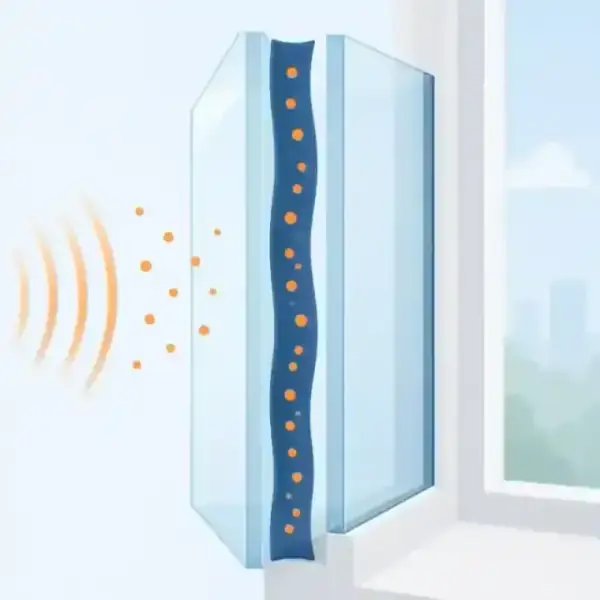
This isn't just glue; it’s a resin specifically engineered to be "viscoelastic." It acts as a shock absorber. When a sound wave hits the first pane of glass, the energy tries to pass through to the second. But when it hits that acoustic interlayer, the vibration is absorbed and turned into a tiny amount of heat. This "dampening" effect breaks the coincidence frequency, ensuring that the glass doesn't "ring" at the same pitch as the traffic outside.
Why Thickness Matters (The Mass Law)
In the world of acoustics, mass is your best friend. The heavier the barrier, the harder it is for sound waves to move it. This is why we often recommend thicker glass for homes facing heavy traffic.
- 6.4mm Laminated Glass: This is a standard safety glass. It’s two 3mm panes with a basic interlayer. It’s better than single glass, but it’s mostly designed not to shatter.
- 10.8mm Acoustic Laminated Glass: This is the heavyweight champion for residential soundproofing. It uses thicker glass and a specialized acoustic interlayer.
When we jump from 6.4mm standard glass to 10.8mm acoustic glass, the results aren't just incremental: they’re transformative. Technical tests show that 10.8mm acoustic glass can provide a 4–7 dB improvement over 6.4mm standard laminate.
That might sound like a small number, but because decibels are logarithmic, a 6 dB reduction is perceived by the human ear as roughly a 60% drop in noise.
The "Silent" Secondary Glazing Advantage
While the glass itself is vital, how you install it matters just as much. This is where secondary glazing becomes the ultimate delivery vehicle for acoustic glass.
If you replace your windows with new double glazing, the two panes of glass are usually only 16mm to 20mm apart. This small gap actually allows sound to "bridge" across the air, sometimes creating a drum-like effect.
By installing secondary glazing inside your existing windows, we can create a much larger air gap: ideally around 100mm. The 100mm gap is the "sweet spot" for soundproofing. When you combine that deep air cavity with the frequency-dampening power of 10.8mm acoustic glass, you can achieve an overall noise reduction of up to 80%.

Real-World Impact: What Does 80% Reduction Actually Feel Like?
Imagine you’re sitting in your living room in Kensington. Outside, the traffic is a constant 75 dB roar.
- With original single glazing: The noise inside is likely around 45–50 dB. You have to turn the TV up, and you can hear every individual car pass by.
- With standard double glazing: The noise might drop to 35–40 dB. It’s better, but the low-frequency rumble of buses still makes the room feel "heavy."
- With Secondary Glazing + 10.8mm Acoustic Glass: The noise floor drops to 25–28 dB. This is the level of a quiet library or a peaceful bedroom in the countryside. The "peaks" of the traffic are flattened into a soft, distant hum that your brain easily ignores.
This isn't just about luxury; it’s about health. Constant exposure to urban noise is linked to increased cortisol levels and poor sleep quality. For many of our clients in London’s most congested areas, achieving 80% noise reduction is the difference between loving their home and wanting to move.
Choosing the Right Glass for Your Home
You don't always need the thickest glass in every room. Here’s a quick rule of thumb we use during our surveys:
- Bedrooms on Red Routes: We almost always recommend 10.8mm acoustic glass. You need the maximum possible dampening to ensure a deep sleep.
- Living Rooms on Side Streets: 6.4mm or 8.8mm acoustic glass is often sufficient. It handles the "city hum" without the extra weight and cost of the 10.8mm units.
- Rear-facing Windows: If your window looks out onto a quiet garden, standard 4mm or 6mm glass might be all you need to boost thermal insulation and cut out the occasional neighbour's lawnmower.

Next Steps for a Quieter Home
If you’re tired of the city noise invading your sanctuary, the first step is to understand what you’re up against. You can find more technical details in our Ultimate Guide to Acoustic Glass, or better yet, have an expert take a look.
Every London property is different: from the thickness of the brickwork to the way the window frames are seated. We don't believe in a one-size-fits-all approach. We’ll measure the noise levels, look at your existing windows, and help you decide if 10.8mm acoustic glass is the right investment for your peace of mind.
Ready to turn down the volume? Get in touch for a free survey and let's see how we can bring some silence back to your London home.
WhatsApp us