
If you live in a London flat, you’ve likely made a silent peace treaty with your windows. You’ve accepted that the low hum of the M4, the sudden scream of an ambulance on its way to St Mary’s, or the winter draft that makes your curtains dance is just part of the "charm" of city living.
But what if you didn't have to? Recent data shows that the average environmental noise level in Greater London sits at a persistent 58 dB, with central hotspots like Westminster often hitting a jarring 70 dB: roughly the same volume as a vacuum cleaner running next to your bed. When you consider that the World Health Organization recommends keeping residential noise below 55 dB to protect your health and sleep, it’s no wonder so many of us feel a little frayed at the edges.
For many homeowners in Kensington, Chelsea, and Westminster, full window replacement isn't an option. Whether it’s because of strict conservation area rules or the hefty price tag of heritage double glazing, the original timber frames have to stay. That’s where secondary glazing steps in.
We sat down with three residents who decided to stop putting up with the noise and the cold. Here is how their homes: and their lives: changed.
Sarah’s Story: Silencing the Kensington High Street "Chorus"
Sarah lives in a beautiful first-floor flat just off Kensington High Street. Her home features stunning, original Victorian sash windows that are the envy of her friends: until they stay for tea.
"Before the installation, my living room felt like it was actually on the pavement," Sarah explains. "I could hear every conversation, every bus engine, and the sirens were so loud they’d stop me mid-sentence during Zoom calls. It wasn't just annoying; it was exhausting."
Sarah’s primary goal was soundproofing her flat in Kensington without losing the historic aesthetic that drew her to the property in the first place.
The Solution: Vertical Sliders
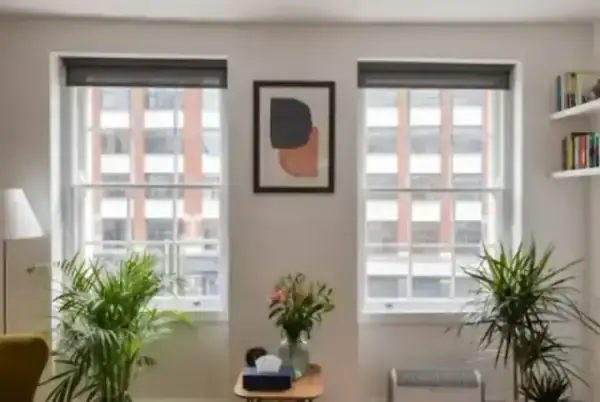
Because her original windows were traditional sash units, we installed bespoke vertical sliders. these are designed to sit discreetly behind the existing frames, with the meeting rails lining up perfectly so they’re almost invisible from the street.
The "After" Reality:
- The Silence: "The first night after the fitters left, I actually thought something was wrong because it was so quiet," she laughs. "The sharp 'edge' of the traffic noise was gone. It went from a 70 dB roar to a faint, distant hum."
- The Usability: The vertical sliders allow her to still open her original windows for ventilation easily.
- The Result: A 70-80% reduction in noise, turning her living room back into a sanctuary.
David’s Story: Beating the Chelsea Drafts
In the heart of Chelsea, David’s Grade II listed apartment was a masterpiece of architecture: and a nightmare to heat. The tall French-style windows were drafty enough that he had to wear a jumper indoors even with the heating on full blast.
"Living in a conservation area means your hands are tied," David says. "I couldn't change the exterior look, but I was sick of my energy bills being through the roof while I was still shivering. I needed a solution for secondary glazing for period homes in London that the council would actually approve."

The Solution: Hinged Units
For David’s elegant, tall windows, we used hinged units. These open like a standard door, providing easy access to the original glass for cleaning while creating an airtight seal when closed. This extra layer creates a pocket of air that acts as a powerful insulator.
The "After" Reality:
- The Warmth: "The draft disappeared instantly. I can sit by the window now without feeling a chill on my neck. My thermostat actually stays at a steady temperature now because the heat isn't just leaking out through the glass."
- The Cost: David found that our solution was roughly 40-60% cheaper than trying to replace his windows with specialist heritage double glazing.
- The Approval: Since the units are installed on the interior and don't change the building's facade, they are the gold standard for listed building upgrades.
James’s Story: Reclaiming Sleep in Westminster
For James, a young professional in Westminster, the issue wasn't the cold: it was the 2 a.m. city "buzz." Living near a busy intersection meant his sleep was constantly fragmented by the "micro-arousals" that noise experts warn about.
"I’d wake up feeling like I’d only slept four hours, even if I’d been in bed for eight," James says. "The background hum of the city never stops in Westminster. I needed a heavy-duty fix."
The Solution: Acoustic Glass
We fitted James’s bedroom with specialist acoustic glass. Unlike standard glass, acoustic glass features a transparent PVB (polyvinyl butyral) interlayer that specifically dampens sound vibrations, making it incredibly effective against low-frequency rumbles like heavy trucks and buses.
The "After" Reality:
- Deep Sleep: "It sounds dramatic, but it changed my mental health. I’m finally getting deep, uninterrupted sleep. The sirens that used to make me bolt upright now sound like they’re miles away."
- Peace of Mind: James didn't have to worry about the disruption of a major construction project. The installation took less than a day, and there was no mess to clear up.
Why it Works: The Science of the "Quiet Gap"
You might wonder how a second thin layer of glass can do what your original windows can't. The secret isn't just the glass itself: it’s the air.
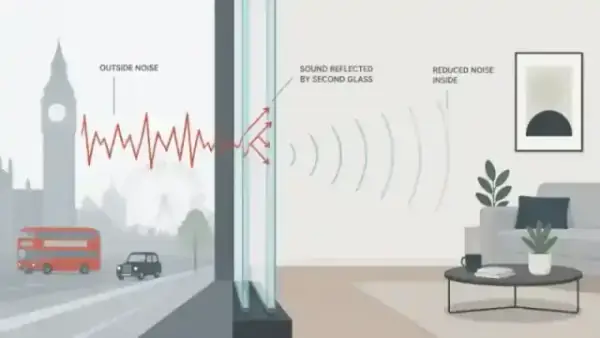
When we install secondary glazing in London flats, we aim for an air gap of around 100mm to 200mm between the original window and the new unit. This gap is the "sweet spot" for acoustics.
- Noise Control: Sound waves lose energy as they travel through the first pane, hit the air gap, and then struggle to penetrate the second pane.
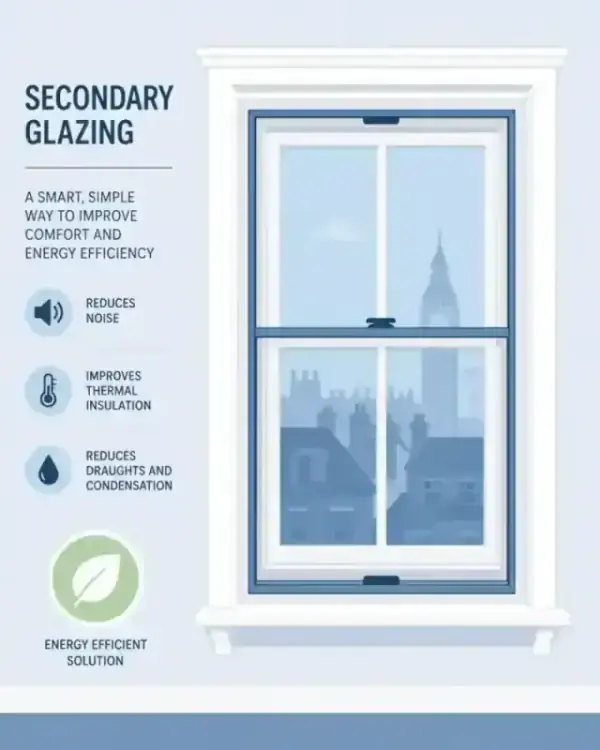
- Thermal Efficiency: This same gap acts as an insulating blanket, significantly lowering your home's U-value (a measure of heat loss). Lower U-values mean a warmer home and lower bills.
Is Your Flat Ready for a Transformation?
If you’re tired of the Kensington chorus or the Chelsea chill, secondary glazing is often the most practical, cost-effective, and respectful way to upgrade your home.
Quick Checklist for Your Home:
- Do you have sash windows? Look at vertical sliders for a seamless look.
- Do you live in a listed building? Hinged or fixed units are usually your best bet for conservation approval.
- Is noise your main enemy? Ask about 6.4mm or 6.8mm acoustic laminate glass.
- Limited space? Lift-out units are perfect for smaller windows or areas where you rarely need to open the glass.
Don't spend another winter shivering or another summer night awake. Whether you're in a Kensington mansion block or a Westminster studio, a quieter, warmer home is much closer than you think.
If you'd like to see how these solutions could fit into your specific space, we’re always happy to pop over for a survey and show you exactly how we can help you reclaim your peace and quiet.