
Meta Description: Escape the roar of London's red routes. Discover the science of acoustic glass and secondary glazing for 80% noise reduction and a peaceful home.
If you live along one of London’s "Red Routes": those major arterial roads like the A1, A40, or the South Circular: you know the sound of the city isn’t just a background hum. It’s a constant, vibrating presence. It’s the hiss of tires on wet tarmac at 6:00 AM, the low-frequency thrum of a double-decker bus idling outside your bedroom, and the occasional siren that cuts through your dinner conversation.
You’ve probably tried heavy curtains or maybe you’ve looked into replacing your windows entirely, only to find that your home is in a conservation area or the cost of full replacement is eye-watering. The good news is that achieving a sanctuary-like quiet isn’t a matter of luck; it’s a matter of physics. By understanding how sound moves through your home, you can use noise reduction windows to effectively "turn down the volume" of London.
Life on the Red Route: The 70-Decibel Reality
To solve the problem, we first have to measure it. Sound is measured in decibels (dB), and it’s important to realize that this scale is logarithmic, not linear. This means a small increase in numbers represents a massive increase in actual noise.
On a typical London red route, façade noise levels often sit between 65 and 75 dB. During peak traffic or at busy junctions, this can easily spike to 80 dB. To put that in perspective:
- 30 dB: A quiet library or a soft whisper.
- 60 dB: A normal conversation.
- 70-75 dB: A vacuum cleaner or a busy London road.
- 80 dB+: A garbage disposal or loud alarm clock.
The World Health Organization (WHO) recommends that for a good night's sleep, background noise in bedrooms should stay below 30–35 dB. If your windows are facing a 75 dB road, you need to block out at least 40 dB of sound. Most standard double glazing simply isn't built for that kind of heavy lifting, often only managing a reduction of about 28–32 dB. This leaves you with an indoor environment that feels "noisy" even when the windows are shut.
The Physics of Peace: How Sound Travels
Sound is essentially a pressure wave: a vibration traveling through the air. When these waves hit your window, they cause the glass to vibrate. Those vibrations then pass through the glass and vibrate the air inside your room, which your ears perceive as noise.
There are three main ways we can stop this:
- Mass: Heavier, thicker glass is harder to vibrate.
- Damping: Using materials that absorb the energy of the vibration (like the PVB interlayer in acoustic glass).
- Decoupling: Creating a physical break so the vibration can't pass easily from one surface to another (this is where the air gap comes in).
Decibels: A Scale That Doesn’t Play Fair
Because the dB scale is logarithmic, every 10 dB reduction is perceived by the human ear as a halving of the loudness. If we can take your red route noise from 75 dB down to 35 dB (a 40 dB reduction), your home will feel sixteen times quieter than it did before. That is the difference between feeling stressed by traffic and not even noticing it's there.
Why Your Current Windows Aren't Enough
Many homeowners assume that modern double glazing is the ultimate solution for soundproofing. However, standard double glazing is designed primarily for thermal insulation, not acoustic performance.
In a standard double-glazed unit, the two panes of glass are usually the same thickness (e.g., 4mm) and are separated by a very small gap (often 16mm to 20mm). This creates a "mass-spring-mass" system. Because the panes are identical, they vibrate at the same frequency: a phenomenon called "sympathetic resonance." When the traffic hits that specific frequency, the window actually becomes less effective at blocking the sound.
Furthermore, the small air gap is too narrow to disrupt low-frequency sounds, like the deep rumble of a bus engine or a heavy lorry. To stop those long, powerful sound waves, you need a much larger "cushion" of air.
The Secret Ingredient: The 100mm Air Gap
This is where soundproof windows in London truly shine. Secondary glazing involves fitting a completely separate, slimline window on the inside of your existing one.
The "magic" happens in the space between the two windows. For maximum noise reduction, we recommend an air gap of at least 100mm, though 150mm to 200mm is the "sweet spot" for high-traffic areas.
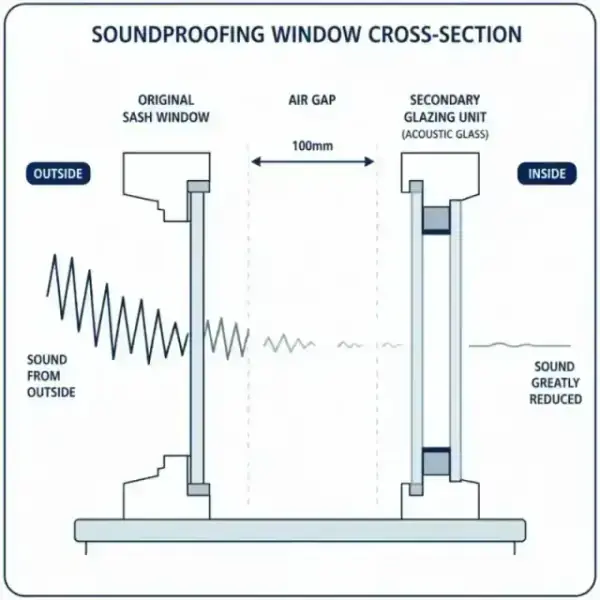
As you can see in the diagram above, when sound waves hit the first pane of glass, they lose energy. They then enter the wide air gap, which acts as a massive shock absorber. By the time the waves hit the second pane of glass (the secondary glazing), they have significantly dissipated. Because the secondary unit is a separate structure with its own seals, it also eliminates "acoustic flanking": the noise that leaks through the gaps in your old sash or casement windows.
We’ve written extensively about why the 100mm gap matters, and in our experience, it’s the single most important factor for red route residents.
Acoustic Glass: The Laminated Life-Saver
While the air gap does the heavy lifting, the type of glass you choose for your secondary unit provides the finishing touch. We often recommend acoustic glass secondary glazing for homes on the busiest roads.
Acoustic glass isn't just "thick glass." It is a laminate made of two layers of glass sandwiched around a special acoustic interlayer (usually Polyvinyl Butyral or PVB).
- The Sandwich Effect: The interlayer acts as a dampening core. When sound energy hits the glass, the interlayer absorbs the vibration and converts it into a tiny amount of heat instead of passing the noise through.
- Asymmetry: By using a 6.4mm or 6.8mm acoustic laminate in your secondary glazing while your original window has 4mm glass, you create "asymmetric glazing." This ensures the two panes don't vibrate at the same frequency, effectively "breaking" the resonance and blocking a wider spectrum of noise.
Beyond Silence: Why This Upgrade Pays for Itself
While your primary goal might be escaping the A40’s roar, secondary glazing offers benefits that go far beyond acoustics.
Dramatic Thermal Improvement
By adding that extra layer of glass and a significant air gap, you are creating a highly effective thermal barrier. This can reduce heat loss through your windows by up to 60-70%. In a city where energy bills are a constant concern, this often means your heating stays off for longer, and your home stays warmer in the winter and cooler in the summer. You can read more about the thermal benefits for 2026 energy bills here.
Preservation of Heritage
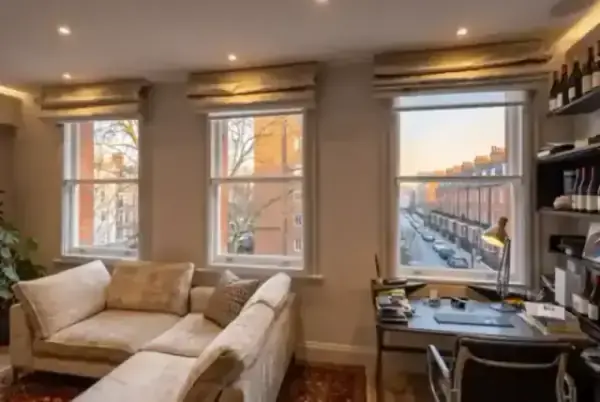
Many London properties on red routes are beautiful Victorian or Georgian terraces with original sash windows. Replacing these with uPVC double glazing often requires planning permission (which is frequently denied in conservation areas) and can strip the character: and value: from your home. Secondary glazing is fitted internally and is virtually invisible from the street, making it the preferred choice for listed buildings and heritage homes.
Making the Switch Without the Drama
One of the most common things we hear from our customers is their surprise at how non-intrusive the process is. Unlike full window replacement, which involves scaffolding, dust, and potentially weeks of disruption, secondary glazing is usually installed in just a day or two. There’s no need to redecorate, and your original windows stay exactly where they are.
Whether you have sliding sash windows, large bay windows, or even arched heritage frames, we can design a bespoke solution that aligns perfectly with your existing frames. Our horizontal sliding units or hinged units allow you to still open your windows for ventilation or cleaning while enjoying total silence when they are closed.
Is It Time to Silence Your Street?
Living on a red route shouldn't mean sacrificing your peace of mind or your sleep. If you’re tired of the traffic and want to explore how the science of soundproofing can transform your home, we’re here to help.
At Secondary Double Glazing London, we specialize in helping Londoners reclaim their homes from the noise of the city. We offer a free, no-obligation survey where we can measure your current noise levels and recommend the perfect combination of air gaps and acoustic glass for your specific needs.
Get in touch with us today to start your journey toward a quieter, warmer, and more comfortable home.