
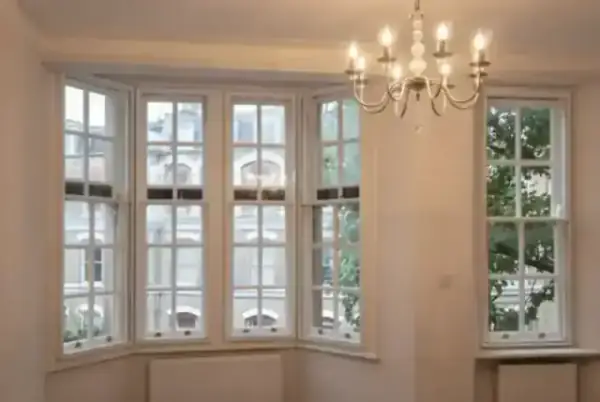
Secondary glazing is an independent window fitted on the room side of an existing window. It can be a practical way to improve comfort while retaining original sash, casement or other heritage windows. The inner frame, glass, seals and air gap are designed around the opening; it is not simply a second pane stuck to the first.
This guide is for UK homeowners comparing warmth, outside noise, character, cost and day-to-day use. The right answer depends on the building and the window in front of you. A survey should come before a final specification.
What secondary glazing actually changes
The original window remains in place and a separate inner unit is added to the reveal. Fixed, hinged, horizontal-sliding, vertical-sliding and lift-out arrangements are all possible in suitable openings. The choice affects ventilation, cleaning, escape access, shutters, curtains and how much reveal space is used.
The second layer can reduce draughts and heat transfer through a suitable opening. It can also reduce some external noise when the glass, cavity and seals match the noise source. It does not repair rotten timber, replace a failed sash cord, stop every route for sound or guarantee a particular energy bill.
For the basic mechanisms, see the beginner’s guide to secondary glazing. For opening styles and more detailed options, use the secondary-glazing options guide.
Thermal performance and U-values
A U-value describes heat transfer through a defined construction. A lower number generally means less heat transfer through that stated construction. It is not a whole-house energy rating or a bill forecast. Glass type, frame, seals, air gap, installation, surrounding wall and the condition of the primary window all affect the result.
The ranges below are indicative references for comparison, not guaranteed outcomes for every UK window. Ask whether a quoted value is measured or calculated and whether it covers the glass, complete window or modelled assembly.
| Window approach | Indicative U-value (W/m²K) | How to read it |
|---|---|---|
| Original single glazing | About 5.0–6.0 | Broad reference range; frame condition and draughts also affect comfort |
| Secondary glazing, standard glass | About 2.4–2.7 | May lower heat transfer in a suitable, well-sealed arrangement |
| Secondary glazing, Low-E glass | About 1.7–1.9 | May improve window-level performance further in a suitable specification |
| Modern replacement double glazing | About 1.4–1.6 | Reference range for a defined new window, not a promise for every product |
An indicative comparison from around 5.0 to 2.0 represents a 60% change in the U-value number. That arithmetic must not be presented as a guaranteed 60% reduction in a household bill. Walls, roofs, floors, doors, ventilation, heating controls, occupancy and energy prices remain part of the result. The secondary-glazing U-value guide explains the measurement limits in more detail.
Noise reduction: what to expect
Secondary glazing can be useful for traffic, aircraft, trains and general urban noise because it separates the original window from an independent inner layer. A larger cavity may help with some low-frequency noise, while acoustic laminated glass can add mass and damping. Continuous seals and a sound primary window matter just as much.
Figures such as 30–45 dB for a basic arrangement or 45–54 dB for a well-specified acoustic system are indicative, specification-dependent references. They may describe a tested component or complete arrangement rather than a room measurement. Walls, doors, vents, roofs and adjoining windows can carry sound around the glazing, so no window can promise silence. Read the soundproof secondary glazing overview for a focused acoustic explanation.
Choosing glass and system type
Standard and Low-E glass
Standard glass may be suitable where the priority is a straightforward thermal or draught improvement. Low-emissivity glass can reflect more heat back towards the room in a suitable build-up, but the quoted U-value still needs its calculation basis. A low number on a brochure is not a property-wide performance guarantee.
Acoustic laminated glass
Acoustic laminated glass uses an interlayer intended to damp vibration. It can be appropriate where external noise is the main concern, but thickness alone does not select the right answer. The noise spectrum, original pane, air gap, frame, seals and installation all matter. Compare like-for-like evidence in the acoustic glass comparison.
Fixed, sliding, hinged and lift-out systems
Fixed units can suit openings that rarely need access, while lift-out panels can provide occasional access if their size and weight can be handled safely. Hinged units can work around casements, and vertical sliders may align with sash windows. Every choice involves trade-offs in operation, cleaning, ventilation, storage, escape routes and reveal space.
Is secondary glazing suitable for sash and heritage windows?
Often, yes, where the original window is structurally suitable and the internal reveal can accommodate the proposed unit. A secondary system can leave the external elevation unchanged and retain original glass and joinery. That is why it is frequently explored for period homes, listed buildings and conservation areas.
“Reversible” and “internal” do not mean automatically exempt from every approval. Listed-building significance, fixings, shutters, architraves, Article 4 Directions, conservation-area policy, lease terms and local authority interpretation can change the position. Check before ordering. The listed-building guide sets out the consent questions, while the sash-window guide covers practical detailing.
The existing window should also be inspected first. Rot, failed putty, water ingress, loose cords, painted-shut sashes and defective perimeter joints may need repair or draught-proofing. An inner pane is not a substitute for sound primary joinery.
Costs and simple payback
Costs vary with the number and size of openings, glass, frame, opening style, finish, access, repairs, installation, VAT and making good. The 2026 UK cost guide is the best place to compare quotation inclusions.
The table is an illustrative planning exercise, not a price promise. The payback calculation is installed cost divided by annual saving; it excludes maintenance, finance, changing energy prices and the value of comfort or retained character.
| Illustrative targeted project | Indicative installed cost | Illustrative annual energy saving | Simple payback illustration |
|---|---|---|---|
| Selected draughty windows | £2,000–£3,000 | £250–£375 | About 8–12 years, only if the assumed saving occurs |
| Wider period-home project | £4,500–£12,000 | Must be modelled for the property | Cannot be inferred from a per-window headline |
Energy savings, payback and replacement comparisons are specification- and property-dependent. Ask for a room-by-room quotation that separates repairs, survey, glass, frames, fitting, access, finishing, VAT and aftercare. A quote claiming a fixed percentage saving without stating assumptions is not a reliable forecast.
Secondary glazing versus replacement or film
Replacement double glazing can provide a strong new whole-window specification, but it may remove or alter original joinery, change external sightlines and trigger heritage or planning questions. Secondary glazing adds internal space and a second layer to operate, but can retain the primary window and provide a large separation between panes.
Window film is not a like-for-like substitute for secondary glazing. It may be a low-cost, temporary or reversible measure for some situations, but it does not create the same independent frame, sealed cavity, opening options or acoustic mass. Compare the purpose and limitations of each approach rather than treating film as an equivalent window system. The window-film comparison explains that distinction.
Survey checklist for a UK homeowner
Before accepting a specification, ask the installer to record:
- the condition, operation and repair needs of each original window;
- reveal depth, meeting rails, handles, shutters, curtains and radiators;
- the proposed glass, frame, seals and air gap for each room;
- how ventilation, cleaning, escape access and summer opening will work;
- what evidence supports each dB, U-value, saving or payback figure;
- which fixings touch historic fabric and whether approvals are required; and
- what the written warranty, maintenance and aftercare cover.
Do not assume one opening style or one glass specification suits the whole house. A bedroom beside a busy road may need a different design from a quiet rear casement or a rarely opened stair window.
Frequently asked questions
Does secondary glazing replace double glazing?
No. Secondary glazing is an independent inner window added behind the existing one. Replacement double glazing is a new integrated unit that replaces the existing glazing or window. Either may be appropriate depending on condition, heritage, cost, access and performance priorities.
Will it cut my heating bills by 60%?
It may reduce heat transfer through suitable windows, but a 60% figure is an indicative comparison for particular constructions, not a promise about the whole home or bill. Energy prices, heating controls, other building elements and household behaviour all matter.
Is a 100mm air gap always necessary?
No. A generous cavity can support acoustic separation in some designs, but available reveal depth, glass, seals, shutters, ventilation and access set the practical specification. The air-gap guide explains the principle.
Does secondary glazing need planning permission?
Internal work may avoid some external-change concerns, but there is no universal exemption. Listed buildings, conservation areas, Article 4 Directions, fixings and local policy can affect the answer. Check with the relevant authority before work begins.
What is the next step?
Start with a measured survey and an itemised quotation. If you would like to discuss the windows, contact SecondaryDoubleGlazing and tell us whether warmth, noise, heritage or day-to-day access is the priority.
SecondaryDoubleGlazing helps UK homeowners make careful, property-specific decisions about original windows. A measured answer is more useful than a headline promise.