
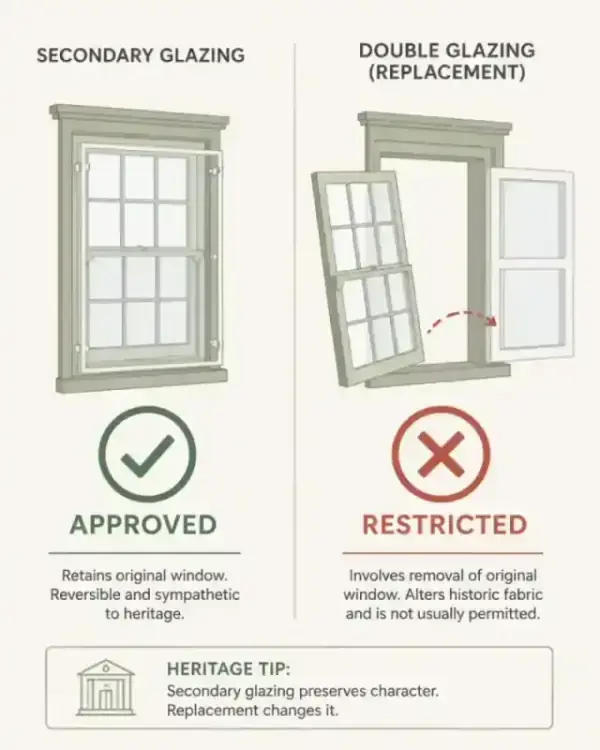
Secondary glazing and triple glazing can both improve comfort, but they solve different project problems. Secondary glazing adds an independent internal window while retaining the original one. Triple glazing normally means replacing the existing window with a new unit containing three panes. The better route depends on thermal targets, noise, heritage, disruption, budget, ventilation and whether the original window is worth preserving.
There is no universal winner. Triple glazing will often offer a lower U-value in a suitable new frame, while secondary glazing can create a much wider separation between the original and inner panes and may preserve the external character of a period elevation. Performance is always system- and property-dependent.
At-a-glance comparison
The figures below are indicative planning references, not guarantees or like-for-like test results.
| Consideration | Secondary glazing | Triple glazing |
|---|---|---|
| Thermal change | Around 65–70% heat-loss reduction may be discussed for a suitable installation | A U-value around 1.4–1.8 W/m²K may be cited for some triple-glazed whole-window specifications; check the frame and calculation basis |
| Acoustic rating | Around 42–50 dB Rw may be cited for particular systems | Around 33–35 dB Rw may be cited for some standard triple units |
| How to read noise figures | System-specific; check glass, cavity, seals, test and frequency | System-specific; pane thickness, cavities, frame and installation matter |
| Indicative cost | About £300–£500 standard; £600–£1,500 acoustic per window | A complete replacement project may be illustrated by £3,500–£5,000 per opening in some heritage comparisons; this is not a quotation |
| Existing window | Retained, subject to condition and access | Usually removed or substantially altered |
| Heritage impact | Internal work may preserve the external appearance | New frames and altered details may require a more involved heritage conversation |
For broader context, some comparisons also use 25–30 dB Rw for original single glazing and 30–35 dB Rw for standard double glazing. All the Rw figures in this table are indicative, test-method-dependent examples, not promises for a particular room. The 65–70% figure is an indicative heat-loss comparison for a suitable secondary-glazing arrangement, not a promised bill reduction. The £300–£500, £600–£1,500 and £3,500–£5,000 figures are planning ranges or comparison examples only; specification, access, repairs, property and supplier change the price.
Thermal performance: lower U-value versus retained fabric
Triple glazing is designed as a sealed factory-made unit with three panes and two cavities. In many suitable modern frames it can achieve a lower U-value than a secondary system. That can be attractive in a new-build or a property already due for full window replacement.
Secondary glazing takes a different route. It can add a second internal barrier to a high-loss single-glazed opening without removing the original frame. A good result may be possible where the reveal can accept the inner unit and the original window is repaired and sealed. The exact outcome depends on the glass, low-E coating, cavity, seals, frame and installation.
For the thermal terminology and indicative U-value ranges, see the period-home thermal standards guide and the 2026 energy-bills comparison. Comfort and whole-house energy use involve more than the window rating alone.
Noise: why three panes are not automatically quieter
Triple glazing adds mass and another cavity, but a narrow, symmetric unit is not automatically the best response to traffic noise. Secondary glazing can use the existing pane, a separate frame and a wider air gap. That separation may be useful for some road-noise problems, particularly when the inner unit is carefully sealed and the glass is chosen for the sound spectrum.
The indicative 42–50 dB Rw secondary-glazing range and 33–35 dB Rw triple-glazing range above are system-specific examples, not a promise that one will sound quieter in every room. Rw is a laboratory rating with a defined test method; it does not describe every frequency or flanking path in a building. Read the acoustic glass guide and ask what noise the proposed build-up is intended to address.
Cost and disruption
Standard secondary glazing may be budgeted at around £300–£500 per window, while an acoustic specification may be around £600–£1,500 per window. These are indicative ranges only. Size, opening style, glass, access, repairs, finish, survey, making good and installation can all change the quote.
Triple glazing usually involves a replacement project. Costs may include removing the original frame, disposal, new reveals or trims, plastering, decoration, scaffolding or access equipment, and changes to handles, sills and ventilation. A lower product price does not necessarily mean a lower installed project cost. Ask for both options to be itemised on the same rooms and openings.
Secondary glazing is often less disruptive because the primary window remains in place, but it is not disruption-free. Inner frames need accurate fixing, the reveal must be accessible, and the room still needs protection and making good. The cost guide sets out the variables to compare.
Appearance and heritage
Retaining an original sash, casement or pane can matter as much as the performance target. Internal secondary glazing may leave the external elevation unchanged and can be designed to align with the original sightlines. It still occupies reveal space and may affect shutters, curtains or the view from inside.
Replacement with triple glazing changes the frame, opening profile, glass reflections and potentially the external appearance. In a listed building or conservation area, consent is case-specific; neither “internal” nor “triple” is a universal approval. Review the listed-building guide, and consult the relevant authority before ordering. Historic England’s guidance is useful background, not a project-specific consent decision.
Which may suit your project?
Secondary glazing may be worth investigating when you want to retain original windows, the external appearance matters, the reveal can accommodate an inner unit, or acoustic separation is a priority. It can also suit a property where full replacement would be difficult or disproportionate. The existing window must still be sound enough to retain, and the design must preserve ventilation and safe operation.
Triple glazing may be worth comparing when the original windows are beyond economical repair, replacement is already planned, a lower new-window U-value is the principal aim, and the frame style and consent position are acceptable. It is not automatically a better acoustic solution, and it is not a drop-in upgrade for a protected period elevation.
A fair quotation checklist
Ask for both options to state:
- the whole-window U-value and the test or calculation basis;
- the acoustic rating, glass build-up, frequency range and test conditions;
- the treatment of the original window and any repairs;
- the cavity or sealed-unit dimensions and impact on shutters and curtains;
- ventilation, escape, cleaning, handles and opening arrangements;
- removal, making good, decoration, access and waste costs; and
- any planning, listed-building, landlord or leaseholder assumptions.
FAQs
Is secondary glazing better than triple glazing?
Not in every situation. Triple glazing often offers a lower U-value in a suitable replacement frame, while secondary glazing may better preserve original windows and can offer useful acoustic separation. The appropriate choice is property- and specification-dependent.
Is secondary glazing quieter than triple glazing?
It can be in some noise-sensitive openings, particularly where a wide cavity, suitable acoustic glass and good seals address the dominant path. The indicative dB ranges are system-specific and should not be treated as a universal ranking.
Does triple glazing always reduce heat loss more?
Triple glazing often has strong thermal performance, but the complete frame and installation matter. A well-specified secondary system may substantially improve an existing single-glazed window. Compare whole-window values and the actual installed scope.
Can triple glazing be fitted to a listed home?
Possibly, but consent and acceptability are case-specific. The frame, external appearance, historic fabric and local policy need to be considered. Do not assume that replacement will be approved or that secondary glazing is automatically exempt.
What is the next step?
Arrange a survey that compares retention and replacement on the same openings. Contact SecondaryDoubleGlazing to discuss the original windows, thermal priorities, noise and the appearance you want to keep.